Originally published on Xiaohongshu on July 12. The timelines below reflect my view when I wrote the original post.
There is broad agreement that agents and LLMs will become productive tools in analog circuit design. Opinions differ sharply on timing: I am optimistic and expect them to enter real workflows within three months; others expect five to ten years.
I want to start with a more fundamental question: what will analog design look like once this happens? To answer it, we first need to look at how programmers work and how AI has changed that work, then at what circuit designers do, and finally at how AI may change analog design.
1. Programmers and the rise of abstraction
A programmer translates human goals and the rules of the world into something a computer can execute reliably.
Over time, programmers have moved away from the lowest levels of code. Machine instructions and registers gave way to assembly, then to higher-level languages such as C and C++, compilers, operating systems and databases. Python made software accessible to people who wanted to solve problems in their own fields without first becoming fully trained software engineers. LLMs and agents extend this: people can use software to solve a problem without knowing how the code is written.
As abstraction rises, writing code becomes easier and the human role shifts toward defining and controlling systems. The scarce skills become defining the right problem, supplying real constraints, judging whether a result holds, and taking responsibility for it.
Working with a coding agent means defining a task, providing context, constraining the implementation, letting the agent execute, checking the result, finding omissions and redefining the task. The agent operates within the goals, context and pass criteria it receives. The person must still judge whether the problem is well defined and which real-world constraints remain implicit. Unlike earlier deterministic layers of abstraction, LLM-based agents are inherently nondeterministic.
2. What analog circuit design does
An analog engineer translates a product's requirements for signals, energy and timing into electrical behavior that is stable, verifiable and manufacturable, subject to process, voltage, temperature, mismatch, noise, power and area constraints.
Let us make that concrete by following a project from the perspective of its analog design lead.
Defining the project
The starting point is creating more value than existing solutions. A project may prioritize cost, performance, schedule or validating commercial feasibility.
Architecture
Architecture develops through repeated movement between top-level needs and uncertainties, candidate architectures, individual blocks and achievable performance.
The first step is usually to identify the dominant constraint and select a reference architecture that comes closest to addressing it. Then calculate its key metrics and the gap to the project's requirements.
Core team members build prototypes to support this iteration. They often uncover unrealistic targets for particular blocks or specifications, or requirements that were overlooked. The emphasis at this stage is understanding principles, physical limits and decisive variables. Those limits guide architecture changes and trade-offs in the top-level requirements.
Architecture iteration ends when the critical assumptions, performance paths and high-risk issues have quantitative support, and there are plausible initial estimates for power and area. The project then has a hierarchy of constraints: signal-chain planning, error budgets, supply domains, power and area budgets, testability, manufacturability, analog–digital interfaces, reliability, block partitioning and specifications.
By the end of this stage, much of the project's technical outcome has already been determined.
Block design
Block design starts with its application boundaries and actual requirements. These determine which specifications can be traded off, which must hold and what to prioritize. The designer balances the overall project goals against design time and project risk.
A sound architecture makes block design easier. Reuse what can be reused, make small changes where appropriate, and deeply understand the core blocks and signal paths.
For those core blocks, clear design theory comes first, and simulations confirm the resulting design. Establish the theory, estimate its behavior across process, voltage, temperature, mismatch and noise, then run the full corner set to find omissions, usually with a specification checklist.
Layout and post-layout simulation
I will leave the details of this stage for another discussion.
3. How AI may change analog design
Entering the workflow
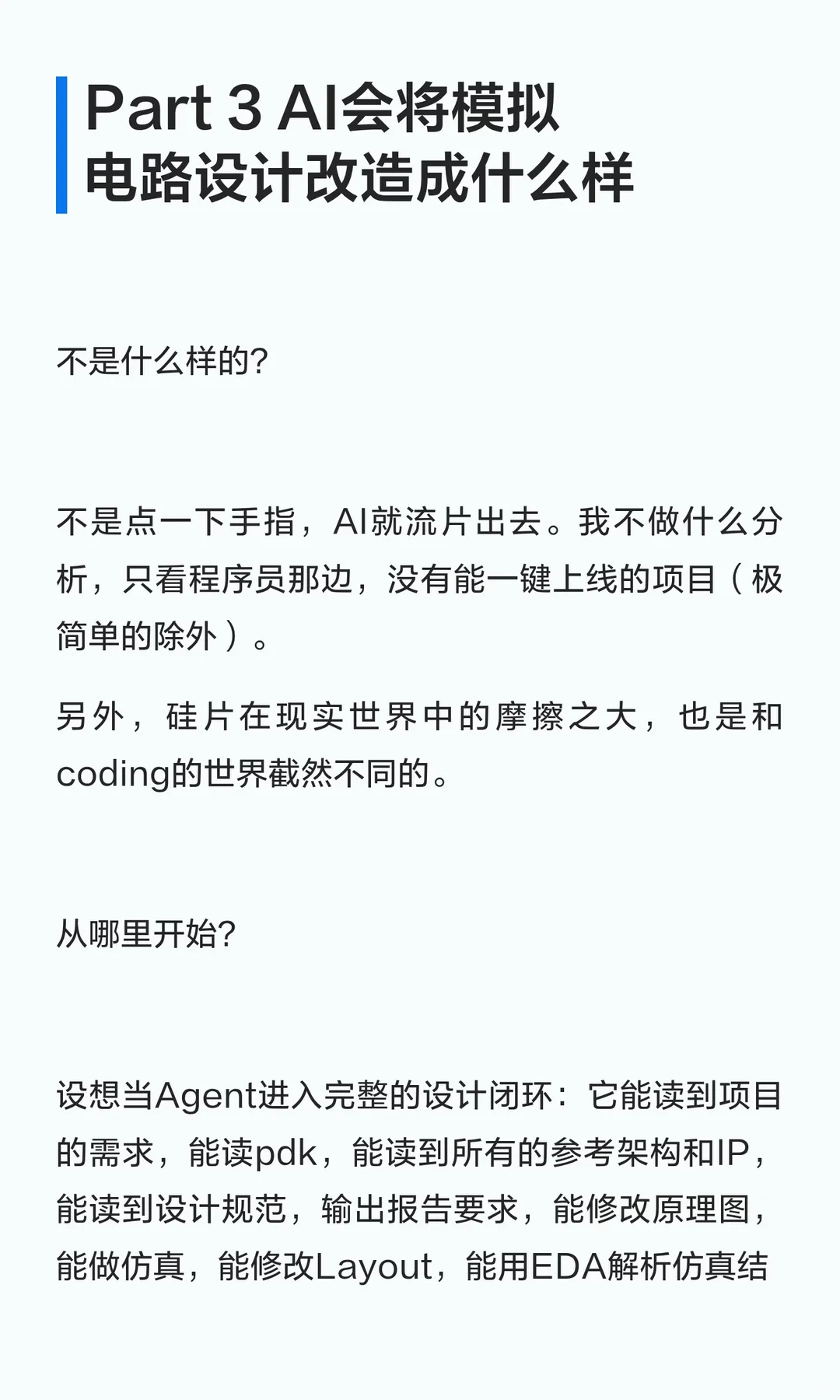
Imagine an agent that can read project requirements, the PDK, reference architectures, existing IP, design rules and reporting requirements. It can modify schematics, run simulations, edit layout, use EDA tools to interpret results and continue iterating against defined criteria.
Supervising it would resemble working with an engineer who has broad knowledge, executes quickly and never tires, but has little practical experience, works remotely and has never encountered the company's unwritten practices.
The first work agents take over is likely to concentrate on block design, simulation, layout checks and test-data analysis. Tasks with clear goals, explicit context and automatically verifiable simulation results are particularly suitable: op amps, oscillators, comparators, references and capacitor DACs, for example.
The direction of change
A block engineer traditionally performs theoretical derivation, topology selection, parameter calculations, schematic construction, testbench development, simulation iteration, corner checks and reporting. An agent may eventually perform most of these steps continuously.
The analog engineer's work then moves upward, as the programmer's has. Simulations and hand-drawn schematics remain, while gradually becoming intermediate outputs.
The engineer defines application boundaries and real requirements, identifies the dominant trade-off, supplies project context, specifies which metrics can be traded off and establishes acceptance criteria. They observe the agent's process, examine key assumptions, explain anomalous results and decide whether a solution should advance. The agent brings unresolved issues back for discussion.
This resembles how an analog design lead supervises a team. Agent capacity can expand, but human review bandwidth has a limit. A good harness protects the engineer's attention by presenting less, more useful output.
The human bottleneck
Engineers can spend more time on higher-level thinking: understanding a circuit, defining useful problems and identifying the real constraints. They still make the judgment that commits a design to silicon under incomplete real-world information.
My rough estimate is that a person's capacity for this kind of intensive judgment is at most six hours a day. Agent capacity can scale; high-quality human judgment time cannot. That makes strong engineering judgment more valuable.
4. When does this arrive?
Soon!
Agents can already connect to the full design workflow. Their ability is improving month by month, especially as agents themselves enter an early period of rapid development.
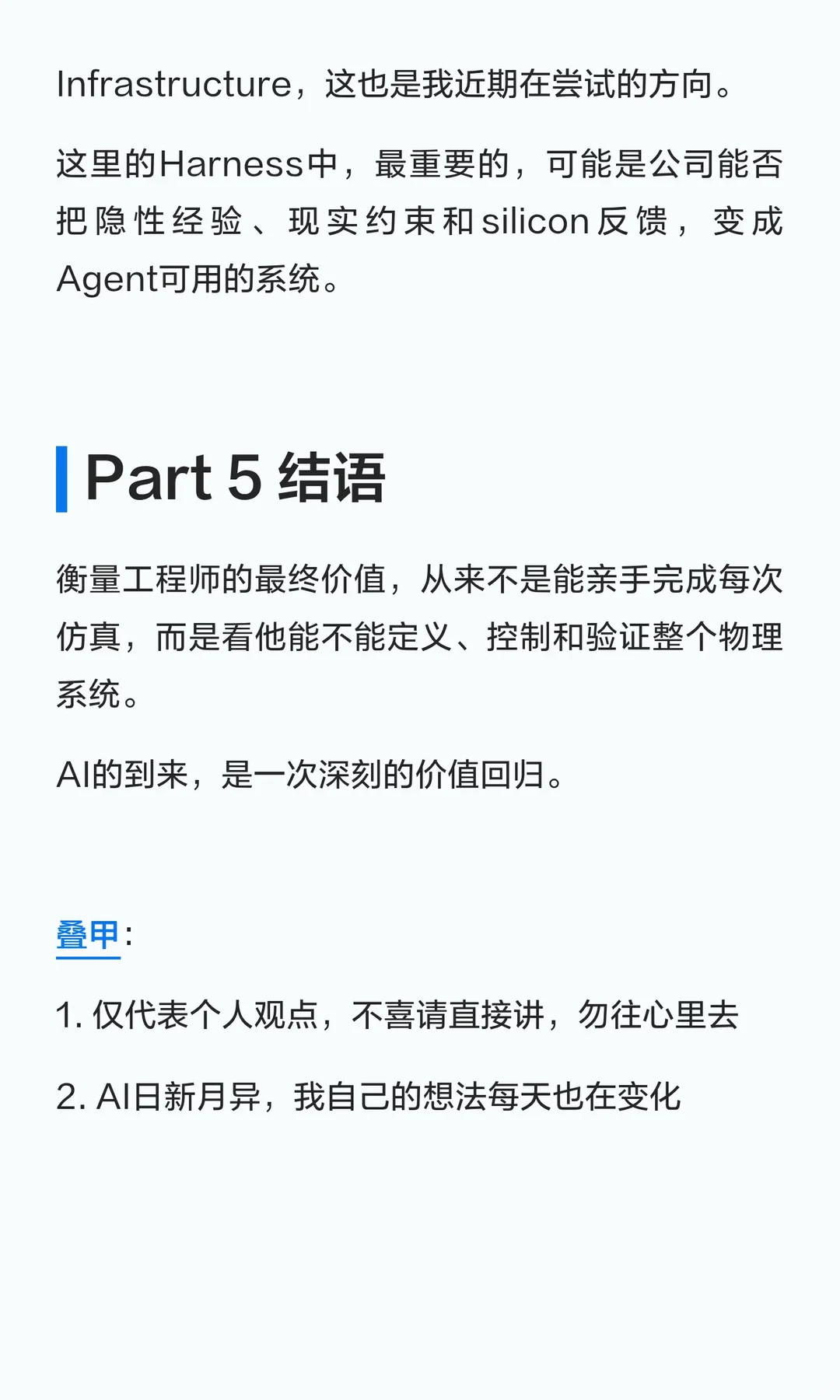
The larger gap may be the harness and infrastructure, which is what I have been exploring. A central challenge is turning a company's implicit experience, real constraints and silicon feedback into a system agents can use.
5. Closing thought
An engineer's ultimate value lies in defining, controlling and verifying the physical system. AI brings that value into sharper focus.
Original image pages (Chinese): 1 · 2 · 3 · 4 · 5 · 6 · 7 · 8 · 9 · 10 · 11 · 12